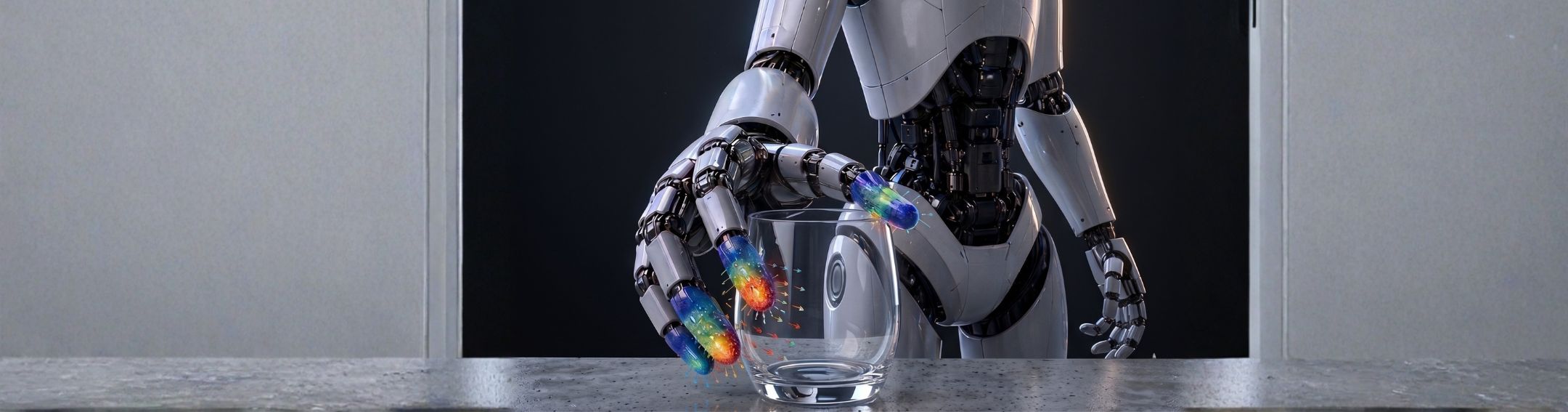
Giving Robots a Sense of Touch
Not properly, anyway.
Cameras can see, force sensors feel the push, but neither truly feels, and in manipulation tasks, that distinction matters enormously.
The Sensing Gap Nobody is Talking About
Today's robotic grippers are remarkably good at applying force. What they struggle with is understanding what's happening at the contact surface, the rich, dynamic exchange of forces that human fingertips process effortlessly and unconsciously.
When you pick up a glass, your fingers don't just apply pressure. They continuously sense micro-shifts, vibrations, and lateral forces, shear forces, that tell you whether the object is stable, slipping, or about to become an expensive mess on the floor. You adjust your grip before you're even aware you've done it.
Robots don't have that, and it shows.
The conventional toolkit falls short in predictable ways:
- Force/torque sensors measure how hard a gripper is squeezing, but are blind to lateral movement within the grasp
- Vision systems are excellent until the moment of contact — at which point the very gripper doing the holding tends to obstruct the view
- Capacitive and piezoresistive pressure sensors register that something is being touched, but not how that contact is evolving in real time
What's missing isn't more force, it's multimodal touch, the ability to sense pressure, shear, slip, vibration, and proximity simultaneously, from the same surface, with minimal overhead.
Enter Shear-Force Sensing
TG0's elastomer-based sensing technology does something the above approaches can't: it monitors the full contact dynamic across a continuous surface.
By capturing both normal and shear force inputs simultaneously, and analysing how those signals change spatially and temporally, TG0's platform gives robotic systems the ability to:
- Detect incipient slip before an object has moved enough for force sensors or cameras to catch it
- Distinguish between stable contact, shifting grip, and active slip in real time
- Respond to nuanced, multi-directional touch, not just binary contact or gross force magnitude
- Maintain environmental awareness through touch alone, independent of vision
The existing approaches have brought us far, now TG0 is defining a new category, a new class of sensing to take robotics to the next stage of development.
Why It Matters for Humanoid Robots (Especially)
For gripper-only applications, shear-force sensing is a significant upgrade, for humanoid robots, it's arguably non-negotiable.
Humanoid hands are expected to operate in human environments, handling objects they've never encountered before, passing tools to colleagues, reacting to unexpected contact on their arms or torso. That requires a continuous, distributed sense of touch across the entire surface of the hand, not just binary pressure at the fingertips.
TG0's platform is uniquely suited to this challenge where the sensing layer is:
- Flexible: conforming to curved, complex hand geometries without sacrificing performance
- Lightweight: adding minimal mass to joints and distal links where inertia matters most
- Low in backend complexity: a single continuous sensing surface replaces arrays of discrete sensors, reducing wiring, calibration overhead, and data pipeline complexity
For engineers already managing the considerable challenge of actuating a dexterous hand, that last point tends to land well.
So, What Does it All Mean?
Robots are approaching genuine usefulness in unstructured environments. The remaining gap isn't compute power, it isn't actuation, and it increasingly isn't perception. It's touch.
The ability to feel, to sense shear, detect slip, interpret contact dynamics, and respond before things go wrong, is what separates a robot that can handle complex objects from one that reliably does.
TG0's shear-force sensing gives robotic systems that capability, without the weight, wiring, or integration complexity that has historically made tactile sensing more trouble than it's worth.
If you're building the next generation of robotic grippers or humanoid hands and want to talk sensing strategy, get in touch, or grab a dev kit and see what your gripper has been missing.
Interested in exploring TG0's tactile sensing platform for your robotics project? Order a dev kit or work with us.

