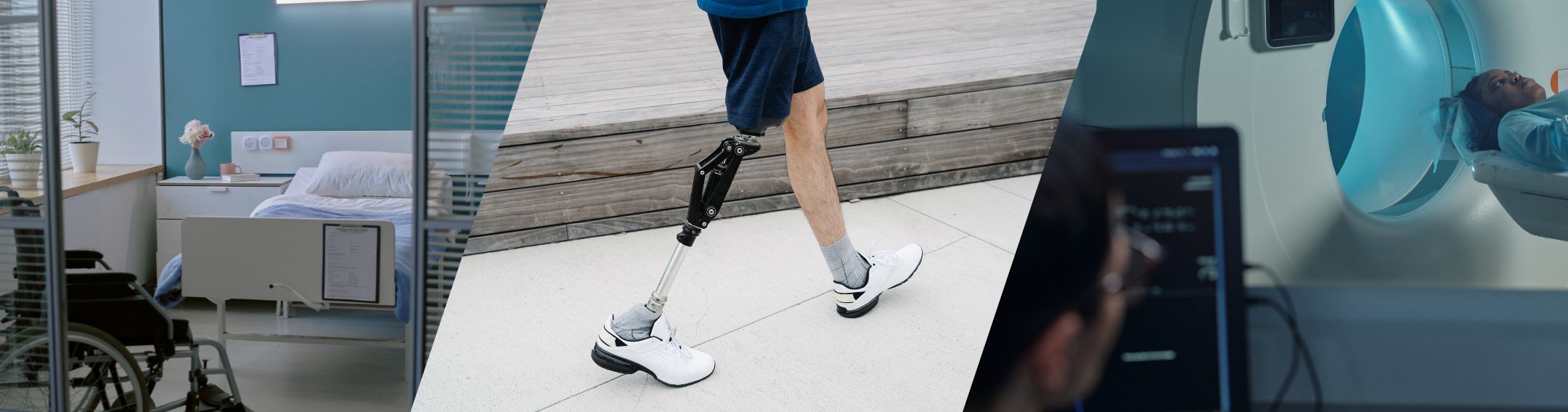
Why Medtech's Most-Used Force Sensor Is Also Its Biggest Design Bottleneck
That's where FSRs quietly start to fail you, not dramatically or on day one, but gradually, in ways that matter enormously when a device is worn by a patient, used in clinical conditions, or expected to survive repeated sterilisation and come back performing exactly as it did before.
The gap between "good enough for a prototype" and "good enough for a product"
There's a familiar arc in medical device development. FSRs make it into an early prototype because they're accessible and fast to work with, the prototype performs well enough in controlled conditions, and then real-world testing begins and the cracks appear.
Sensitivity drift means the readings that were accurate in week one are subtly off by week eight. Exposure to moisture, sweat, sterilisation fluid, the general humidity of a clinical environment, degrades performance over time. The form factor that worked on a flat prototype surface becomes awkward when the design evolves into something more ergonomic or contoured. And if the application involves repeated compression across millions of cycles, as is common in patient support equipment, rehabilitation aids, and long-term monitoring devices, FSRs simply aren't built for that kind of endurance.
This isn't a criticism of FSRs as a technology. It's a recognition that they were designed as a quick, affordable sensing tool rather than a long-term clinical component. The problem is that the gap between those two things only becomes visible late in the development process, when changing course is expensive.
What medical device teams actually need from a force sensor.
Spend time with engineering teams building rehabilitation aids, patient positioning equipment, or wearable monitoring devices, and the real requirements become clear quickly.
Durability that doesn't drift. A sensor embedded in a hospital bed mattress overlay, a wheelchair cushion, or a rehabilitation boot needs to perform consistently across millions of compression cycles. A reading that drifts even by 8% over six months isn't a minor inconvenience, it's a clinical data quality problem that undermines the device's value entirely.
Sealed by design, not by workaround. IP-rated devices can't have exposed sensor layers or adhesive interfaces that invite moisture ingress. The sealing solution needs to be integral, not added on afterwards. Every additional protective layer introduced to compensate for an FSR's vulnerability is another potential point of failure, and another step in manufacturing.
Form that follows function. The most important sensing surfaces in supportive medical devices are rarely flat like a wheelchair cushion conforming to the body, a hospital bed insert follows the contours of the mattress system, or a light and ergonomic rehabilitation grip. Force sensors that only work reliably on flat substrates constrain the design before it has even properly begun.
Data richness, not just on/off. Binary pressure detection, force applied: yes or no, has limited clinical value in most modern applications. What changes patient outcomes is continuous, multi-point pressure data: where exactly the force is, how it's distributed across a surface, and how it changes over time with movement and posture. That's the level of insight that catches a pressure injury before it forms, confirms a seating position is correctly offloading risk areas, or tracks how a patient's weight distribution is shifting during recovery.
A different approach to force sensing
TG0's pressure sensing platform takes a fundamentally different approach to how sensing is embedded into a product. Rather than placing discrete sensors at fixed points on a surface, TG0's technology turns the surface itself into the sensing element, using conductive materials shaped directly into the product form. Whether that's a flat insert for a mattress system, a curved cushion liner, or a contoured grip surface, the entire area becomes a continuous pressure mapping zone with no gaps, no adhesive interfaces, and no exposed electronic components.
The practical implications for medical device design are significant. Because there are no printed ink layers or laminated films, there is nothing to peel, crack, or separate over time, so the sensing element remains structurally sound throughout the product's life. A seamless, gapless construction makes IP67+ ratings achievable without additional protective films or gaskets, which matters enormously for devices that need to survive regular cleaning, autoclave cycles, or prolonged contact with the body. Unlike FSRs, where the sensing range is fixed by the component specification, TG0's material stiffness and sensitivity can be tuned to the specific application, so the sensing solution is matched to the use case rather than the other way around. And because the sensing isn't dependent on a flat substrate, it can be moulded into complex three-dimensional forms, meaning product shape is determined by what works best for the patient rather than by where the sensor can physically fit.
There's a manufacturing benefit too. Replacing a multi-part FSR assembly with an integrated sensing surface reduces BOM complexity, fewer components, fewer suppliers, fewer assembly steps, and lowers the number of potential failure points, both of which matter considerably when a device is moving towards regulatory submission and volume production.
Where this makes a real difference in supportive medtech
The applications where TG0's approach changes what's possible are precisely the ones where patients spend the most time and where the consequences of sensing failure are most serious.
In pressure injury prevention, continuous surface-wide mapping across a wheelchair cushion or hospital bed overlay can detect the early redistribution signals that precede tissue damage, long before a patient would report discomfort or a clinician would notice anything during a routine check. That kind of early warning requires not just a sensor, but a sensor that maintains its accuracy across months of continuous use and daily cleaning cycles.
In MRI and imaging environments, the constraints become even more demanding. Ferromagnetic components are off the table entirely, and the ability to monitor patient positioning and movement during a scan without introducing any interference is genuinely difficult with conventional sensing approaches. A fully sealed, non-metallic pressure mapping surface that can operate within the bore without affecting image quality opens up clinical monitoring possibilities that simply aren't achievable with standard sensing components.
In rehabilitation and mobility aids, the value of consistent, high-resolution pressure data compounds over time. Whether it's tracking how a patient's gait loading pattern changes week by week during recovery, monitoring whether a seating system is maintaining correct postural support, or providing objective data to inform equipment adjustments, the clinical utility depends entirely on the sensor being as reliable on day three hundred as it was on day three.
A look at what's coming next
Force sensing in medical devices has historically focused on measuring pressure perpendicular to a surface. But some of the most clinically relevant interactions, the shear forces that contribute to pressure injuries in immobile patients, the lateral forces in mobility and positioning equipment, involve force applied in multiple directions simultaneously. TG0 is developing shear-force sensing technology that begins to address this gap, bringing a capability that has previously existed only in specialist research settings into the realm of real-world product integration. It's early, but it points to where supportive medtech sensing is going.
The sensor your product deserves
FSRs have helped a lot of great medical products get off the ground, and they'll continue to have a role in certain applications. But the next generation of supportive medtech, smarter pressure injury prevention systems, more intelligent rehabilitation tools, positioning and monitoring devices that genuinely improve clinical outcomes, needs sensing technology that can match the ambition of the products it's embedded in.
The constraints that come with traditional force sensing components shouldn't be the thing that limits what a device can do for patients. They're engineering trade-offs, and engineering trade-offs are exactly what TG0 was built to solve.
If your team is working on a medical device that needs force or pressure sensing and you've hit the ceiling with current solutions, we'd like to talk.
Related reading:
Under pressure: how we design a pressure mapping insert
Finding comfort with fitted prosthetics
Smart rehabilitation aids with pressure sensing technology

